



Request for Proposals: IFA x Dr Ashok Da Ranade Archives | Deadline: July 10, 2026 (CLOSED)
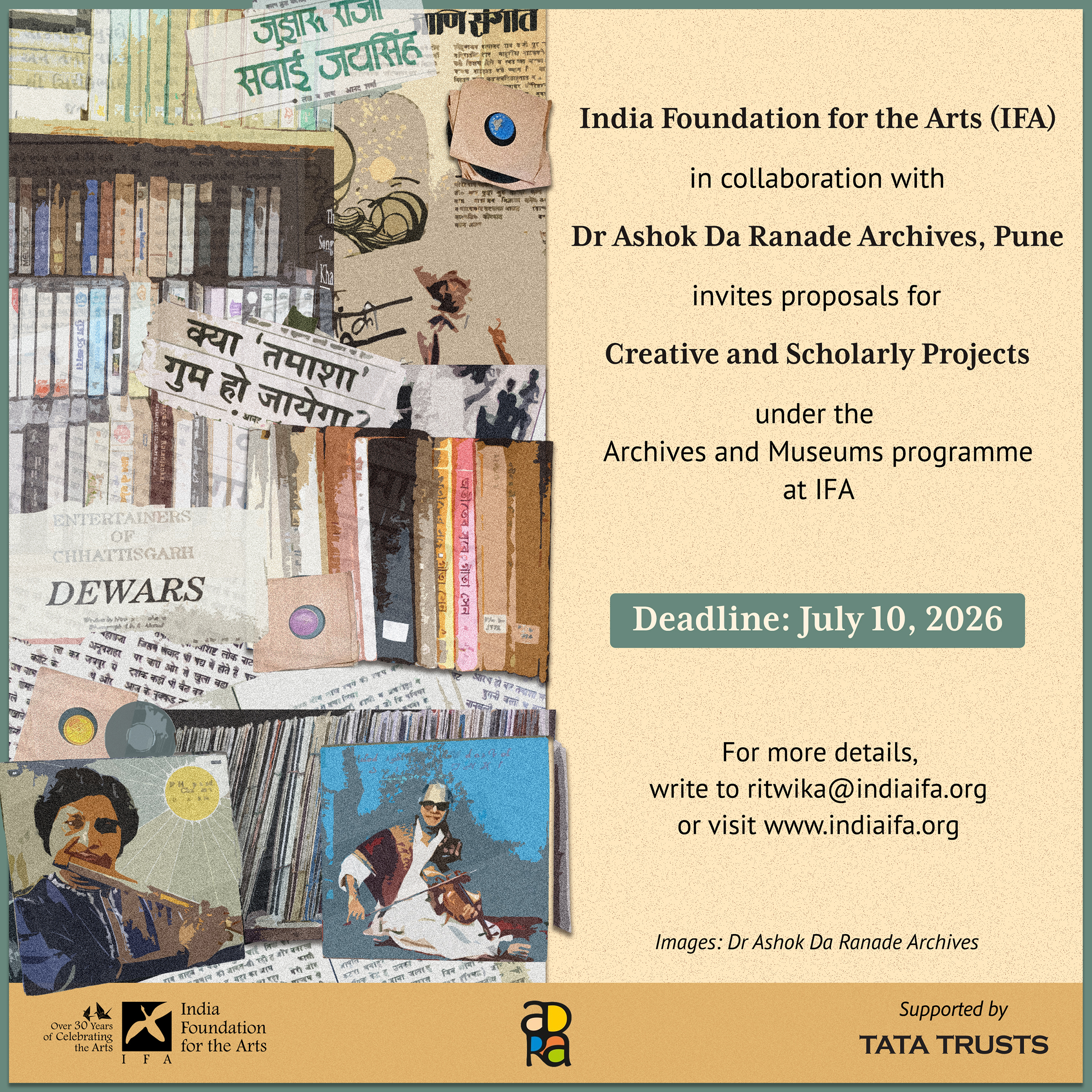
IFA, in collaboration with Dr Ashok Da Ranade Archives, Pune, Maharashtra invites applications for Creative and Scholarly Projects under our Archives and Museums programme. The programme has a twofold objective: to provide arts practitioners and researchers with an opportunity to generate new, critical and creative approaches for public engagement with archives and museum collections; and to energise these spaces as platforms for dialogue and discourse.
Read about earlier projects under this programme.
About the Dr Ashok Da Ranade Archives
Dr Ashok Da Ranade Archives (ADRA) for research and studies in Performing Arts and Culture was established in 2014 under Maharashtra Cultural Centre in Pune. The archive has been initiated by Dr Keshavchaitanya Kunte, a performer, composer, researcher and disciple of Dr Ranade. Its foundation has been laid in line with the expansive vision of scholar-musician late Dr Ashok Damodar Ranade, one of the most respected scholar-musicians of India. He contributed immensely to the development of Indian Ethnomusicology with his path-breaking initiatives and body of work. The archive consists of his collection of wide-ranging and rare material from over the 50 years of his ethnomusicological journey.
Along with Dr Ranade’s collection, several musicians and veterans have donated their personal collections to ADRA, such as Sardar Abasaheb Mujumdar, Malini Rajurkar, Sunita Khadilkar, Veenapani Shukla, WW Kale, Dr Balwant Dixit, etc. ADRA is committed to the preservation and digitisation of this treasure-house of resources on the performing arts and making it available to students, researchers and performers. The archive and its collection echoes the values of Dr. Ranade who emphasised that scholarly enquiry and the performing tradition are not two separate paths, they are intertwined aspects of ethnomusicology.
About the Collection
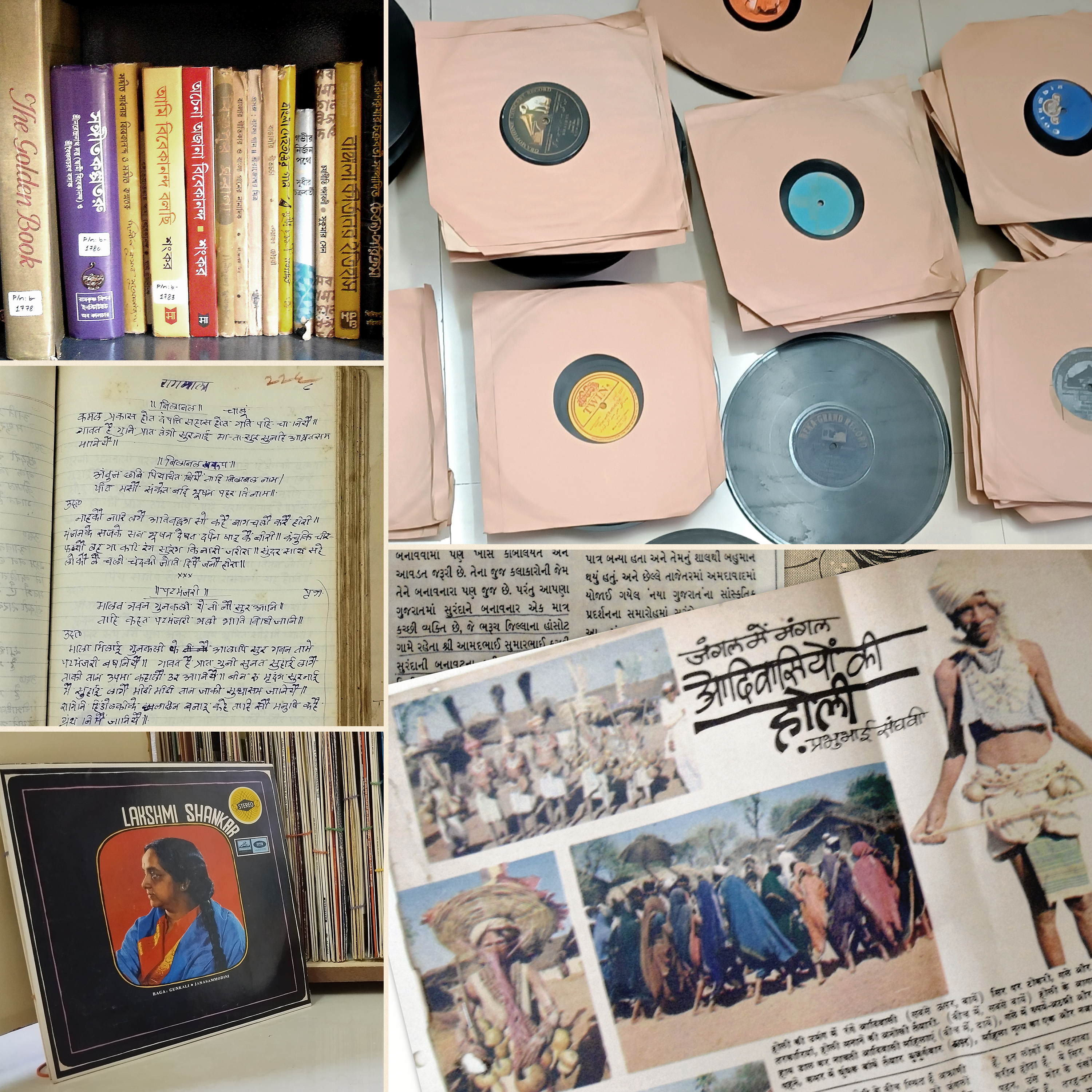
The resources preserved at ADRA consist of more than 4,500 books and press clippings, handwritten notes, photographs and other publications in English, Hindi, Marathi, Bangla, and Gujarati, on a wide variety of subjects related to the world of the performing arts, culture, anthropology, folklore, and literature of India. More than 2,500 hours of audio-visual material on gramophone records, cassettes and digital formats are available at ADRA.
Click here to view the listing of some of the records.
About the Scope of IFA-ADRA Scholarly and Creative Projects
The entire collection and resources at ADRA will be available for these projects. We invite proposals from those interested in engaging with materials at the archives to create outcomes that disseminate and transform academic research into interactive and approachable material. Considering the diversity of subject areas and the formats of resource material at ADRA, we invite applications that can explore possibilities of projects in the wider realm of performing culture and humanities. We are looking for projects that demonstrate an ability to think through interdisciplinary and collaborative approaches and methodologies for their outcomes. Applicants who are keen to produce work in Indian languages are encouraged to apply.
For the Scholarly Project:
We encourage proposals that
- Create research-based outputs around the inter-relation between oral traditions and the texts, transitions in the performance idiom in India, listening cultures of Maharashtra and Bengal
- Initiate scholarly work around themes of interactions between city cultures, regional art practices, food culture and its impact on performance
- Present new research by interpreting the music recordings as performing repertoire or explore historicity of theoretical texts and their reflections on the performing tradition.
For the Creative Project:
We encourage proposals that:
- Study, analyse, and reinterpret the materials at ADRA to reconstruct the performing material
- Initiate oral history projects, curatorial intervention exploring around listening cultures of Maharashtra and Bengal; themes of interactions between city cultures and regional art practices; food culture and its impact on performance
- Can use the notations and recordings stored at ADRA to build innovative performance pieces
- propose and implement digital-born projects and multimedia outcomes
On selection, the Project Coordinators will need to research and critically engage with the collections at the physical space of the ADRA in Pune, Maharashtra. During the course of the project, one can refer to the books from the reference library. There are also consoles to listen to music/audio files and videos. The archive has facilities of photocopying and scanning of materials required, as the material is not available for home lending. If required, collective listening sessions from the music archives can be arranged. Project Coordinators will have access to the materials throughout the duration of the project. For more information about the collections and materials available for research, please contact Dr Keshavchaitanya Kunte, Founder Director and Shruti Kunte, Curator at ADRA at ashokdaranadearchives@gmail.
Duration of the Project: Up to 15 months
Budget
- The project cost should not exceed Rs 3,00,000/-
- Applicants can include an honorarium for themselves not exceeding 30% of the proposed budget for the entire duration of the project. The total amount is inclusive of the honorarium.
Funds will cover only project-related costs and activities, and will not pay for infrastructure costs or equipment purchase.
Who Can Apply?
We seek applications from performing artists, curators, designers, researchers and students of performing culture, curators, art-educators, writers, other creative practitioners, and scholars with a background in research and a keen interest in working with archival collections of performing traditions.
Eligibility
- Only Indian nationals can apply. This does not include PIO (Persons of Indian Origin) and OCI (Overseas Citizen of India) Card Holders.
- Applicants must have a PAN card and one of the following for proof of identity and citizenship – Indian Passport or Aadhar Card or Voter’s ID in India.
- Only individuals can apply. Organisations of any kind cannot apply.
- If there are collaborators in the projects, they must also be Indian nationals.
- Persons who have a past history of financial delinquency with IFA are not eligible.
- Persons who have failed to deposit at IFA agreed deliverables from an earlier IFA grant are not eligible.
- Persons who have previously received a letter from IFA disallowing them from applying in the future for any reason are not eligible.
- Persons currently working on a project implemented by IFA are not eligible to apply.
- More than one individual can apply if they have a joint account. If they do not, then only one among them should apply with the others as collaborators.
Submission Guidelines
You can write your proposal in any Indian language, including English.
Send us the following in a single email:
- A proposal briefly describing the project (as described in the call with outlines of creative outcomes that one can imagine, or research questions if it is a Scholarly project) that could be developed from the visual and textual materials mentioned above. The description should include the vision, approach and possible outcomes.
- A brief note with selected ideas on public programming
that could be developed from the proposed outcomes. - Detailed timeline for the project.
- Detailed budget.
- Your CV with a brief description of a project you have been involved with as a curator, arts practitioner, or researcher. This description should comprise the vision, processes, and outcomes from that project. Please send us a document with links and not attachments.
Email your applications or any queries to Ritwika Misra at ritwika@indiaifa.org with the subject line: Application for IFA-Dr Ashok Da Ranade Archives Project
Please note that all queries will be addressed only between 09:30 AM to 05:30 PM from Monday to Friday.
Key Dates:
- Deadline for final applications: July 10, 2026
- Interviews with shortlisted candidates: August 2026
- The project will commence by September 2026 for a period of 15 months.
IFA will implement this project with you directly as Project Coordinator.
Please note that IFA is committed to creating a safe environment that supports, respects, and protects everyone, including children. The applicant must be aligned with this and must uphold it at all times.
The Archives and Museums programme is supported by Tata Trusts.