



Request for Proposals: Archives and Museums programme | IFA x Conflictorium | Deadline: December 05, 2025 (CLOSED)
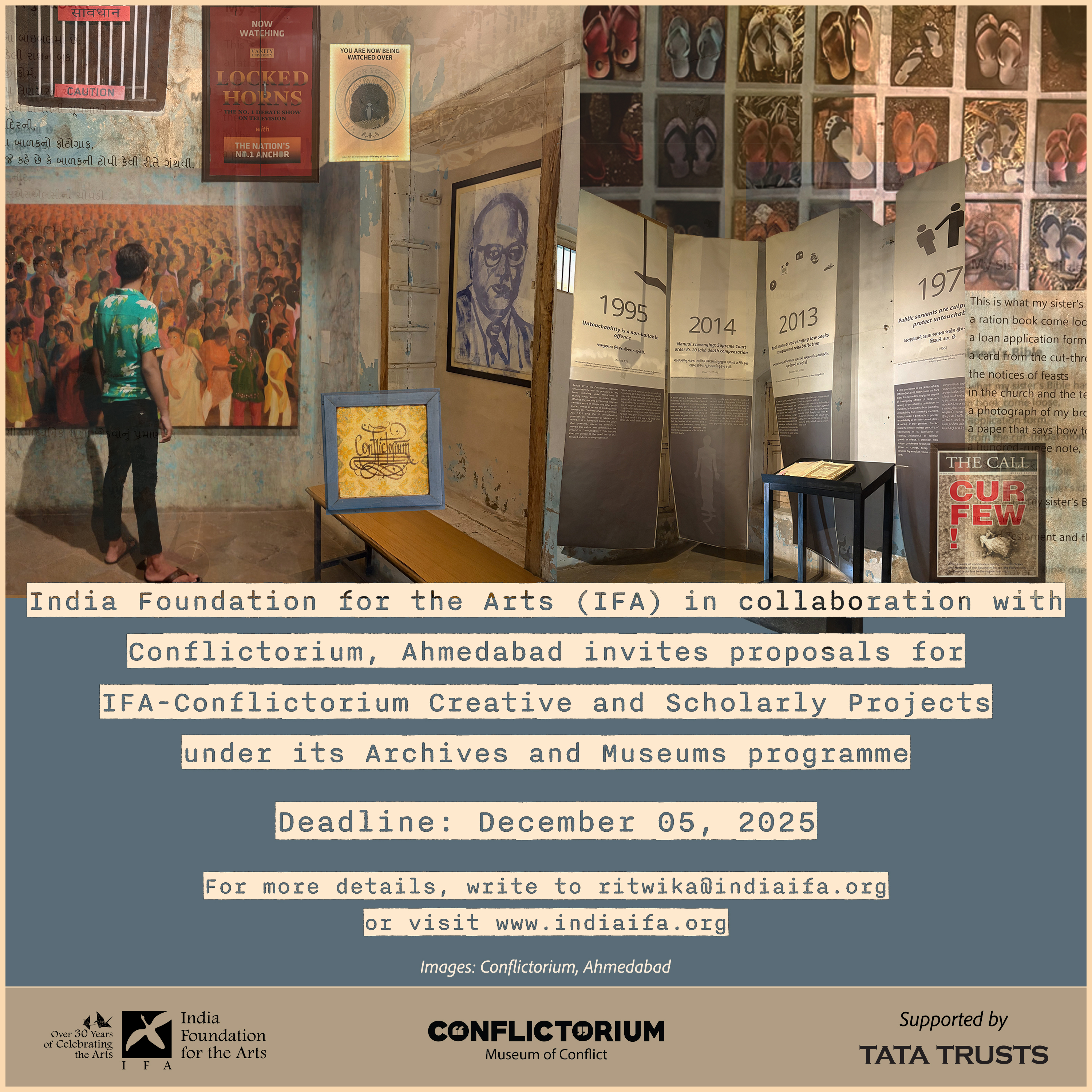
IFA, in collaboration with Conflictorium - Museum of Conflict, Ahmedabad, Gujarat invites applications for IFA-Conflictorium Creative and Scholarly projects, under our Archives and Museums programme. The programme has a twofold objective: to provide arts practitioners and researchers with an opportunity to generate new, critical and creative approaches for public engagement with archives and museum collections; and to energise these spaces as platforms for dialogue and discourse. Read about earlier projects under this programme.
About Conflictorium:
Conflictorium - Museum of Conflict, is a participatory museum centred on conversations of conflict—social, political, cultural, and personal. Established in 2013, the Conflictorium resides in the erstwhile Gool Lodge in Ahmedabad.
With emphasis on art, audience and archives, where intersectional and interdisciplinary approaches to peace and conflict are explored, the museum tries to acknowledge the phenomenon of “conflict” as a key move in imagining a peaceful society. While the idea of conflict conventionally refers to overt violences like war, the museum understands conflict as everyday tensions and disruptions that often manufacture and reveal the larger fears, shame and guilt operating to build miscommunications and boundaries between people.
About the Collection:
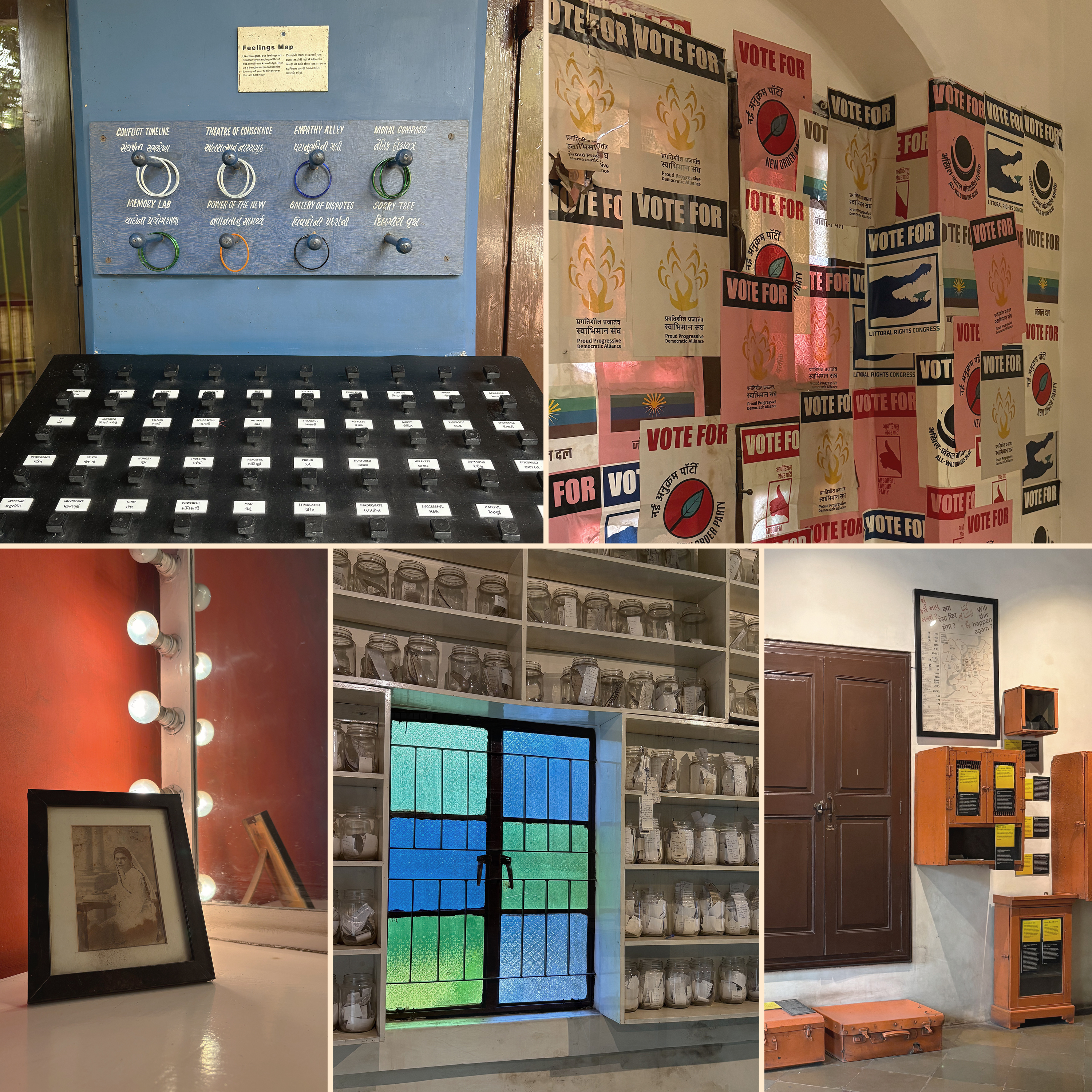
The Conflictorium has seven sections:
- Conflict Timeline: A long‑form wall timeline tracing major episodes of violence and resistance in Gujarat since statehood, inviting a reading of history beyond event headlines and its overt manifestations.
Research and Curatorial possibilities: Historiography labs; micro‑oral histories linked to dates; student walk‑along that annotate the timeline; data visualisations; multilingual counter‑timelines by communities. - Gallery of Disputes: An immersive gallery that stages everyday disputes - especially of Caste, Gender, Labour - and their structural roots through light, sound, and allegorical storytelling - partly inspired by George Orwell’s Animal Farm.
Research and Curatorial possibilities: Performance ethnography; participatory storyboards with visitors; sound essays; comic/animation commissions unpacking dispute resolution. - Empathy Alley: A corridor of silhouettes of key nation‑making figures with archival speeches in their original voices, placing divergent and contradictory ideologies in the same room.
Research and Curatorial possibilities: Listening sessions and annotation; comparative readings for schools; speech‑to‑text captioning and translations; debate clubs; creative responses to archive audio (scores, choreographies). - Moral Compass: An accessible copy of the Indian Constitution placed for public reading and touch, foregrounding rights, duties, and constitutional method.
Research and Curatorial possibilities: Constitution reading circles; rights literacy workshops; article‑wise zines; legal literacy toolkits; datasets on which constitutional provisions visitors consult most. - Memory Lab: Shelves of glass jars where visitors deposit handwritten notes of personal conflicts and memories—an ever‑growing, anonymous archive.
Research and Curatorial possibilities: Thematic cataloguing and digitisation; privacy‑first metadata protocols; exhibitions based on emerging affective patterns; artist books and sonic readings of memory jars. - Sorry Tree: A peepal tree that invites the public to write and hang apology notes (to self to society) - an embodied ritual of acknowledgement and repair.
Research and Curatorial possibilities: Public ceremonies around apology; seasonal harvests of notes and anonymised datasets; school activities on empathy; site‑specific performances and film essays. - Reading Room: A reference space with literature - speculative fiction, nonfiction, academic essays, zines, children's books, pictorial books etc.
Research and Curatorial possibilities: Residency desks; study groups; editorial clinics; small zine library; digitisation and oral history stations during project term.
About the Scope of the Creative and Scholarly Projects:
The entire collection and resources available at the museum will be available for these projects. We welcome applications that:
- activate museum rooms as “Parliament/s”,
- are interested in engaging with materials at the museum, various archives and cultural institutions in Ahmedabad and
- disseminate and transform academic research into interactive and approachable material.
- demonstrate an ability to think through interdisciplinary and collaborative approaches and methodologies for their outcomes.
For the Scholarly Projects, we encourage proposals that:
- present the research through outcomes like research papers, room-wise cataloguing projects, de-identified data sets or finding aid for the museum, public lectures, schools/college modules, teacher toolkits, workshops, educators’ kits.
For the Creative Projects, we encourage proposals that
- demonstrate innovative curatorial and artistic interventions to existing curated installations, rearticulating or redesigning existing installations to respond to the current times and/or curate temporary and travelling exhibitions
- propose and implement public outcomes such as new artworks, performances, films, zines, creatively annotated audio-transcripts, digital storytelling, podcasts, digital microsite either emerging from the existing collection or responding to the current times
- disseminate the possible outcomes through offline and online public programming
We welcome possibilities of outcomes that may not necessarily cover the ones mentioned above. Project Coordinators will need to research and critically engage with the collections at the physical space of the museum in Ahmedabad in Gujarat through fieldwork. Project Coordinators will have access to the materials mentioned above, over the duration of the project. For more information about the collections and materials available for research, please contact YSK Prerana, Artistic Director, at dialogue@conflictorium.org
Duration of the Project: Up to 15 months
Budget:
- The project cost should not exceed Rs 3,00,000/-
- You can request for an honorarium not exceeding 35% of the proposed budget for the entire duration of the project. The total amount is inclusive of the honorarium.
Funds will cover only project-related costs and activities, and will not pay for infrastructure costs or equipment purchase.
Who Can Apply?
We seek applications from curators, artists, art-educators, researchers, writers, performers as well as other creative practitioners, and scholars with a background in research and a keen interest in working with museum collections.
Eligibility:
- Only Indian nationals can apply. This does not include PIO (Persons of Indian Origin) and OCI (Overseas Citizen of India) Card Holders.
- Applicants must have a PAN card and one of the following for proof of identity and citizenship – Indian Passport or Aadhar Card or Voter’s ID in India.
- Only individuals can apply. Organisations of any kind cannot apply.
- If there are collaborators in the projects, they must also be Indian nationals.
- Persons who have a past history of financial delinquency with IFA are not eligible.
- Persons who have failed to deposit at IFA agreed deliverables from an earlier IFA grant are not eligible.
- Persons who have previously received a letter from IFA disallowing them from applying in the future for any reason are not eligible.
- Persons currently working on a project implemented by IFA are not eligible to apply.
- More than one individual can apply if they have a joint account. If they do not, then only one among them should apply with the others as collaborators.
Submission Guidelines:
You can write your proposal in any Indian language, including English.
Send us the following in a single email:
- A proposal briefly describing the project (as described in the call with outlines of creative outcomes that one can imagine, or research questions if it is a Scholarly project) that could be developed from the materials mentioned above. The description should include the vision, approach and possible outcomes.
- A brief note on other public programmes that could be developed from the material.
- Detailed timeline for the project.
- Detailed budget.
- Your CV with a brief description of a project you have been involved with as a curator, arts practitioner, or researcher. This description should comprise the vision, processes, and outcomes from that project. Please send us a document with links and not attachments.
Email your applications or any queries to Ritwika Misra at ritwika@indiaifa.org with the subject line: Application for IFA - Conflictorium Project
Key Dates:
- Deadline for receiving applications: December 05, 2025
- Interviews with shortlisted candidates: January 2026
- The project will commence by February 2026 for a period of 15 months
IFA will implement this project with you directly as Project Coordinator.
Please note that IFA is committed to creating a safe environment that supports, respects, and protects everyone, including children. The applicant must be aligned with this and must uphold it at all times.
The Archives and Museums programme is supported by Tata Trusts.