



Request for Proposals: IFA x Chandernagore College Museum | Deadline Extended: September 17, 2025 (CLOSED)
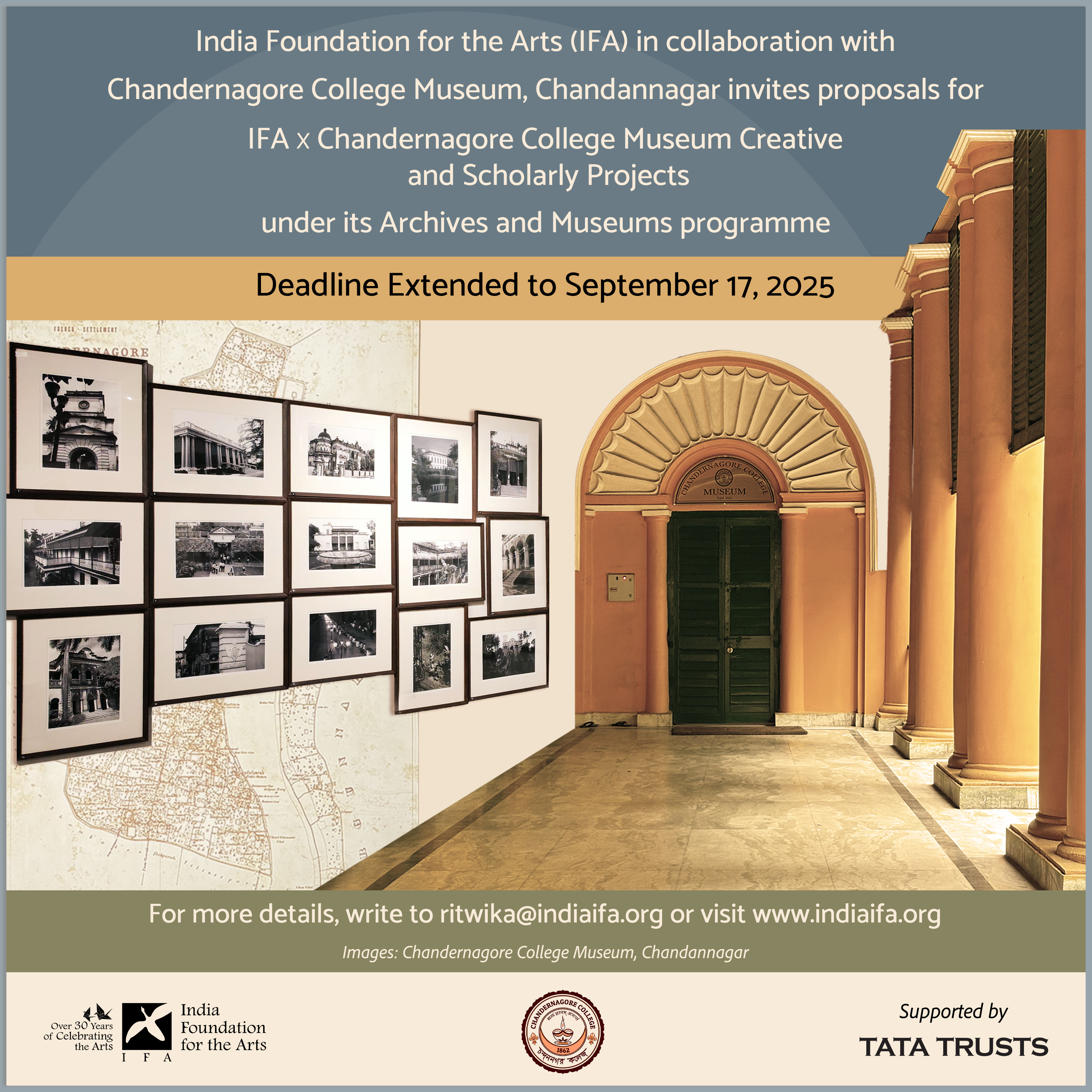
India Foundation for the Arts (IFA), in collaboration with the Chandernagore College Museum, Chandannagar, West Bengal invites applications for IFA-Chandernagore College Museum Creative and Scholarly projects, under our Archives and Museums programme. The programme has a twofold objective: to provide arts practitioners and researchers with an opportunity to generate new, critical and creative approaches for public engagement with archives and museum collections; and to energise these spaces as platforms for dialogue and discourse. Read about earlier projects under this programme.
Click here to read the call in Bangla
About Chandernagore College Museum
Set up in 2023, the museum is located in Chandannagar, West Bengal, a city that was once a flourishing trading centre, an erstwhile French colony and is an important cultural site at the present. Born out of the Heritage Studies initiative undertaken by the Chandernagore College, the museum was set up to commemorate the legacy of the armed freedom fighters associated with the College and the city of Chandannagar. The museum also foregrounds the social, political, economic and cultural heritage of the city. To know more about the history of the Chandernagore College and its initiatives, click here
About the Collection
The museum consists of four rooms with their own specific thematic focus.
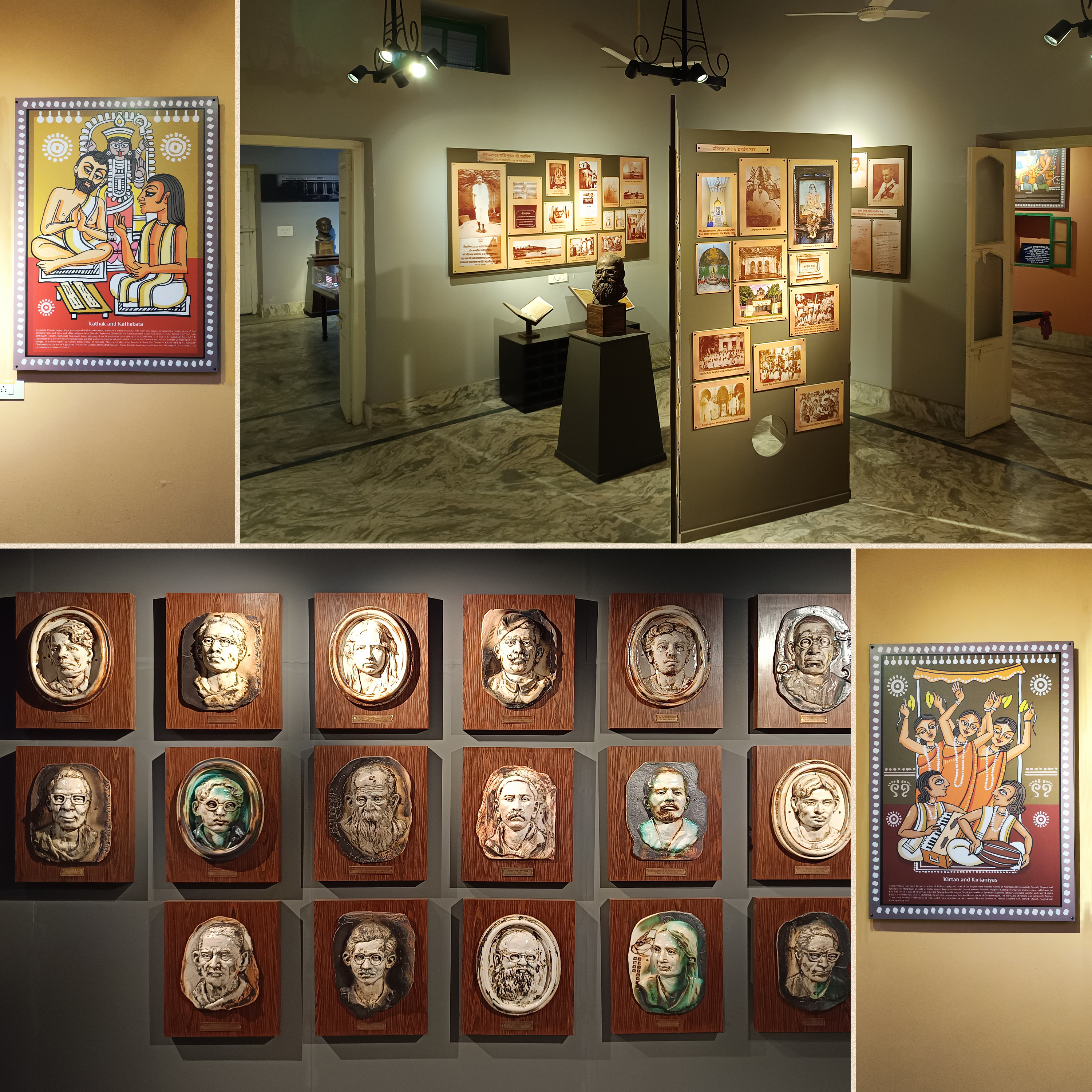
- Room One focuses on the history of the city and its evolution. It houses a series of photographs detailing the journey of the city—from its earliest beginnings to its present state—its architectural heritage, including monuments declared as heritage properties by the West Bengal Heritage Commission, as well as historical sites that have now become extinct. The photographs act as evidence of invariant features of the city as well as changes across time. In addition, this section also has illustrated depictions foregrounding the relationships of different luminaries of Bengal with Chandannagar.
- Room Two is dedicated to an under-explored and lesser known historical past of the city—the lives and legacies of revolutionaries like Kanailal Datta, Makhanlal Ghoshal, Motilal Roy and several others. Through a combination of displays, installations, photographs, sculptures, and work of the revolutionaries, this section offers a sensorial experience of the revolutionaries and their journey.
- Room Three acts as a repository of archival documents, showcasing the diverse aspects of revolutionary activities emanating from Chandannagar.
- Room Four hosts a traditional loom and weaving machine related to the extinct art of weaving associated with Forashdanga (an older name of Chandannagar). There are also illustrations of Chandannagar’s socio-cultural history and the indigenous traditions of physical exercises and combat sports which had flourished in Chandannagar, in defiance to colonial stereotypes of sedentary lifestyle and effeminacy.
Currently the museum is also working on a section that brings together various artefacts like coins, musical instruments, objects used by revolutionaries, furniture, old newspapers, utensils etc donated by the citizens of Chandannagar.
About the Scope of the Creative and Scholarly Projects
Since its inception, the museum has welcomed a diverse group of visitors like students, tourists, local community as well as international visitors. The unique nature of the museum lies in the way it brings forth the history and culture of the city through its tangible and intangible heritage, people, and their lived histories using mostly secondary sources and materials. To extend these efforts, we invite applications that explore the idea of ‘City as a Museum’—a way to look at the city both as a resource for history, narratives, collections as well as participation that takes the experience of a museum beyond its physical premises.
The entire collection and resources available at the museum will be available for these projects. We welcome applications interested in engaging with materials at the museum, various archives, oral histories and community narratives from Chandannagar and disseminate and transform academic research into interactive and approachable material. For example, proposals that seek to research and create materials on the lives and association of armed revolutionaries with the city through forms of interactive booklets, graphic novels etc.
We are looking for projects that demonstrate an ability to think through interdisciplinary and collaborative approaches and methodologies for their outcomes. Applicants with knowledge of Bangla, who are keen to produce work in bilingual fashion are encouraged to apply.
For the Scholarly Project, we encourage proposals that
- create research-based materials around the subject of architectural heritage of Chandannagar, its history, influences, initiate oral or audio-visual documentation of narratives regarding lesser-known and under-explored histories of the city
- initiate oral history projects or audio-visual documentation capturing the narratives from senior citizens of the community around the history and Chandannagar’s independence from French rule through the historic referendum of 1949
- present the research through public outcomes like podcast, audio-guides, audio-visual recordings, digital mapping, and other online and/or offline modes
For the Creative Projects, we encourage proposals that
- demonstrate innovative curatorial and artistic intervention to reimagine the collection
- are interested in generating greater popular awareness about the museum collection through creation of finding-aid, online repository, interactive stories, guided walkthroughs, walking tours and disseminate possible outcomes through offline and online public programming
- propose and implement digital-born projects and multimedia outcomes
Project Coordinators will need to research and critically engage with the collections at the physical space of the museum in Chandannagar in West Bengal and the city itself through fieldwork. Project Coordinators will have access to the specific materials mentioned above, over the duration of the project. For more information about the collections and materials available for research, please contact Chandana Banerjee, Assistant Professor of History at Chandernagore College at chandana.banerjee@
Duration of the Project: Up to 15 months
Budget
- The project cost should not exceed Rs 3,00,000/-
- You can request for an honorarium not exceeding 35% of the proposed budget for the entire duration of the project. The total amount is inclusive of the honorarium.
Funds will cover only project-related costs and activities, and will not pay for infrastructure costs or equipment purchase.
Who Can Apply?
We seek applications from curators, artists, art-educators, researchers, writers, performers as well as other creative practitioners, and scholars with a background in research and a keen interest in working with museum collections and the idea of ‘city as a museum’
Eligibility
- Only Indian nationals can apply. This does not include PIO (Persons of Indian Origin) and OCI (Overseas Citizen of India) Card Holders.
- Applicants must have a PAN card and one of the following for proof of identity and citizenship – Indian Passport or Aadhar Card or Voter’s ID in India.
- Only individuals can apply. Organisations of any kind cannot apply.
- If there are collaborators in the projects, they must also be Indian nationals.
- Persons who have a past history of financial delinquency with IFA are not eligible.
- Persons who have failed to deposit at IFA agreed deliverables from an earlier IFA grant are not eligible.
- Persons who have previously received a letter from IFA disallowing them from applying in the future for any reason are not eligible.
- Persons currently working on a project implemented by IFA are not eligible to apply.
- More than one individual can apply if they have a joint account. If they do not, then only one among them should apply with the others as collaborators.
Submission Guidelines
You can write your proposal in any Indian language, including English.
Send us the following in a single email:
- A proposal briefly describing the project (as described in the call with outlines of creative outcomes that one can imagine, or research questions if it is a Scholarly project) that could be developed from the visual and textual materials mentioned above. The description should include the vision, approach and possible outcomes.
- A brief note on other public programmes that could be developed from the material.
- Detailed timeline for the project.
- Detailed budget.
- Your CV with a brief description of a project you have been involved with as a curator, arts practitioner, or researcher. This description should comprise the vision, processes, and outcomes from that project. Please send us a document with links and not attachments.
Email your applications or any queries to Ritwika Misra at ritwika@indiaifa.org with the subject line: Application for IFA - Chandernagore College Museum Project
Key Dates:
- Deadline for receiving applications: September 17, 2025
- Interviews with shortlisted candidates: October 2025
- The project will commence by October 2025 for a period of 15 months
IFA will implement this project with you directly as Project Coordinator.
Please note that IFA is committed to creating a safe environment that supports, respects, and protects everyone, including children. The applicant must be aligned with this and must uphold it at all times.
The Archives and Museums programme is supported by Tata Trusts.
Images: Chandernagore College Museum, Chandannagar.