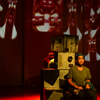
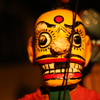
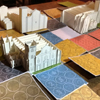
For a grant supporting the creation of multiple artistic interpretations of Nabarun Bhattacharya’s novel Lubdhak. A graphic novel which will serve as a script for a feature length stop motion animation film later, will be created in the process. An electronic version of the graphic novel and a prototype of a short film for the animation will also be made. Grant funds will cover travel and food costs, material, props and lighting costs, professional fees, studio rental, documentation and an accountant’s fee.
For the creation of a performance themed around narratives of the hair. Titled ‘A Brief History of Your Hair’, the performance draws upon personal, historical, political and gender narratives of the hair and uses humour, playfulness and fantasy to unpack questions of identity, androgyny, gendered beauty and the way these ideas relate to each other across cultures. The performance is expected to premiere in March 2016. Grant funds will pay for professional fees, performance costs and production costs.
For the creation of a performance that explores the functioning body as contraposed to the performative and productive body. Primarily through the act of jumping, the project seeks to understand and engage with the body outside the frameworks of the performative, competitive, virtuosic or aesthetic. The performance will be created by a team of ten people from diverse backgrounds in the arts, fitness and sports.
For a graphic narrative and a series of performances, on the untold stories of migrant labourers and their tools, as they transform the history of the city of Delhi. These stories provide perspectives from those who have come from the outside to make this city their home, as the city grows in shape and size. A prototype of the graphic novel, performances and their documentation will be produced as outcomes.
For a production on the theme of the mobile phone and its impact on our lives, which is an extension of the theatre group’s endeavour of building theatre pieces based on objects. It questions the effect of technology on our individual and community lives, while simultaneously using the object and its social practices as material for the performance. While the production will be the main outcome of the grant, a detailed documentation of the processes including rehearsal notes, photographs and audio-video recordings, will also be delivered.
For exploring the socio-cultural, historical and psychological understandings of doll traditions in southern Tamil Nadu, towards creating a new language of performance. Through an investigation into the myths, movements, language, songs and politics of these doll traditions, the study seeks a deeper understanding of the nuanced performative elements embedded in these traditions. The outcome of the research will be a performance script.
For a puppetry workshop, over eighteen days, for eight participants from diverse artistic backgrounds, with a traditional master Kathputli practitioner from Rajasthan – Puran Bhatt. The third in a series of IFA funded workshops, this is another step towards addressing the need for building a robust discourse and pedagogy for puppetry in India, through intensive training, discussions and artistic exchanges, between traditional and contemporary puppeteers and other arts practitioners who draw from puppetry in form, content or aesthetics.
For the development of a game-art environment, by a moving image artist, based on the speculations around the remains of Queen Ketevan of Georgia in Goa. Using archival materials, the project aims to question the legitimacy of proof in the reading of history, while experimenting with the limits of film, games and the digital media. The outcome of the project will be an installation that will allow interaction between traditional board games and interactive screen games, ideally, situated in a gallery.
For artistically representing the untold private lives of veteran Jatra artists, photographed while performing their beloved characters in costume within their quotidian environments. While the photographs push the boundaries of documentation and performance, raising questions about history and authenticity, they are also witnesses of the transforming face of Jatra. The outcome will be an exhibition of these photographs where some Jatra artists will talk about their experiences dressed as characters.
For the creation of a theatrical production that explores the position of women, roles of women characters and streevesha (female impersonation) within the male-dominated practice of Yakshagana. Drawing from research and personal experience, the performance imagines a reversal of roles in the popular Yakshagana plot of Draupadi Vastrapaharana, thereby exploring the conflicts around tradition, gender, power and morality inherent in the form. The performance is scheduled to premiere in Udupi in November 2015.